Electricity bills have become an important household expense for many Canadians. From refrigerators and washing machines to televisions, computers, and heating systems, modern homes depend on electricity throughout the day. As energy costs continue to affect household budgets, many consumers are exploring different ways to reduce their electricity consumption without sacrificing everyday comfort.
The StopWatt Electricity-Saving Box Canada is marketed as a compact electrical device designed to help homeowners manage electricity more efficiently. According to its promotional materials, the product is intended to stabilize electrical current, reduce certain forms of electrical interference, and potentially help protect connected household electronics.
Its small design and straightforward concept may appeal to people looking for a convenient alternative to complicated home energy upgrades. However, before purchasing an electricity-saving product, Canadian consumers should understand what it claims to do, how similar devices work, and whether the advertised savings are supported by reliable evidence.
This StopWatt Electricity-Saving Box Canada review examines the product’s advertised features, potential advantages, limitations, and practical considerations to help readers make an informed decision.

What Is StopWatt Electricity-Saving Box?
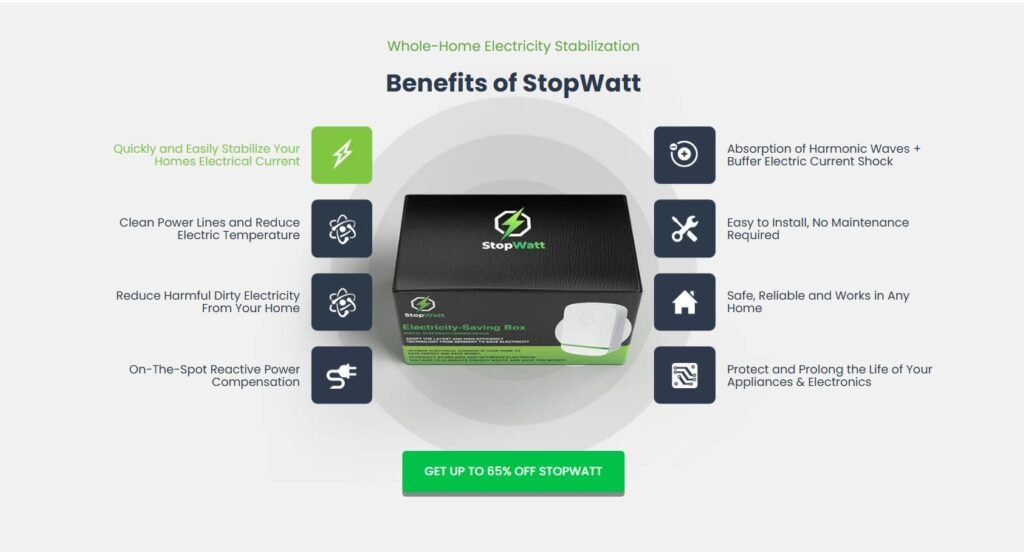
StopWatt is presented as a plug-in electricity-saving device intended for residential use. The promotional image shows a compact white unit with a green indicator and branding, designed to connect to an electrical outlet.
The manufacturer or seller promotes the product as a convenient way to address electrical fluctuations and improve household electrical efficiency. Its marketing also suggests that the device may help reduce unnecessary electricity costs and extend the lifespan of appliances and electronic equipment.
Unlike solar panels or major home energy-management systems, a small plug-in device does not require a large installation project. Nevertheless, a simple installation process does not automatically mean a product can deliver significant energy savings.
For Canadian households, the most important consideration is whether StopWatt can demonstrate measurable reductions in electricity consumption under normal operating conditions.
How Does StopWatt Claim to Work?
StopWatt is advertised as a device that interacts with household electrical current. Its promotional materials refer to stabilizing electricity and reducing what they describe as undesirable or unstable electrical power.
To understand these claims, it helps to distinguish between different electrical concepts.
Electrical power quality: Power quality describes characteristics such as voltage stability, frequency, and electrical disturbances. Problems with power quality can sometimes affect sensitive equipment or industrial systems.
Power factor correction: Certain electrical equipment draws reactive power, which can affect power factor. Specialized correction equipment may improve electrical efficiency in suitable installations. However, the benefit depends on the electrical load and system configuration.
Electricity consumption: Residential electricity use is generally measured in kilowatt-hours (kWh). A household’s energy consumption depends on how much power its appliances use and how long they operate.
These concepts are related, but they are not interchangeable.
A small plug-in device cannot automatically reduce the energy required by every appliance in a home. For ordinary residential loads, improving power factor does not necessarily reduce the number of kilowatt-hours recorded by the electricity meter.
Therefore, StopWatt’s specific mechanism and any claimed savings should be verified through independent testing rather than assumed from its advertising.

Main Features of StopWatt Electricity-Saving Box
1. Compact and Simple Design
One advertised advantage of StopWatt is its compact form. The device is designed to fit into an electrical outlet without requiring extensive installation work.
This format may appeal to homeowners who prefer simple household products instead of complex electrical modifications.
Before use, consumers should confirm that the exact model is compatible with Canadian electrical outlets and the voltage supplied by their electrical system.
2. Plug-In Operation
StopWatt is promoted as a plug-in device. This type of product generally aims to offer a straightforward user experience without extensive wiring or technical setup.
However, consumers should follow the manufacturer’s instructions and avoid using any electrical product that lacks appropriate safety certification.
3. Advertised Electrical Stabilization
The product’s promotional materials suggest that it can help stabilize household electrical current.
Electrical stabilization can be valuable in certain circumstances, but the effectiveness of a particular device depends on its actual design and technical capabilities.
Consumers should look for independent test results explaining precisely what the product changes and whether those changes produce measurable benefits in a typical Canadian home.
4. Claimed Appliance Protection
StopWatt is also marketed as a product that may help protect appliances and electronics.
It is important to understand that power conditioning, surge protection, and voltage regulation are different functions. A device should not be assumed to provide all three unless its specifications and independent testing establish that capability.
People concerned about electrical surges should consider properly rated surge-protection equipment and consult a qualified electrician when necessary.
5. Promotional Money-Back Guarantee
The supplied promotional image advertises a 60-day money-back guarantee, along with shipping and return assurances.
These terms should be confirmed directly with the seller before ordering. Buyers should review the complete refund policy, including the return deadline, shipping costs, eligibility requirements, and the process for requesting a refund.
A guarantee is only useful when its terms are clear and the seller honours them.
Potential Benefits for Canadian Households
StopWatt’s advertised benefits may attract consumers who want to lower household expenses. However, it is important to separate the product’s marketing claims from benefits that have been independently demonstrated.
Convenience
A compact plug-in product can be easier to install than a major electrical upgrade. This convenience may appeal to renters and homeowners who want a simple product.
Nevertheless, ease of installation does not establish energy-saving performance.
Interest in Lower Electricity Bills
Reducing electricity consumption is a practical goal for many households. A product that demonstrably reduces energy use without creating additional costs could be useful.
At present, consumers should not assume that StopWatt will deliver a particular percentage of savings without credible independent evidence.
Potential Relevance to Electrical Power Quality
Some electrical systems benefit from specialized power-quality equipment. However, whether such equipment is useful depends on the electrical problem being addressed.
For a typical household, reducing the electricity consumed by heating equipment, water heaters, lighting, and appliances is generally a more direct approach to lowering the electricity bill.
Simple Household Energy Awareness
Researching products such as StopWatt can encourage consumers to examine their energy habits and identify opportunities to improve efficiency.
Tracking electricity usage and comparing monthly bills can help households understand which changes produce meaningful results.
Is StopWatt Electricity-Saving Box Effective?
This is one of the most important questions for anyone considering a purchase.
Although StopWatt’s advertising promotes electricity savings and improved electrical stability, its effectiveness should be evaluated using independent measurements.
A convincing test would compare electricity consumption before and after installation while keeping appliance usage and other relevant conditions consistent. Ideally, the testing would be conducted by an independent laboratory using appropriate equipment and clearly documented methods.
The results should show whether the device reduces the kilowatt-hours measured by the electricity meter, rather than simply changing voltage, current, or power factor readings.
Consumers should also look for information about the exact model tested, the electrical loads used, the duration of testing, and whether the results have been independently replicated.
Without reliable evidence, it is not possible to confirm that StopWatt will substantially lower a Canadian household’s electricity bill.
Be cautious of advertisements promising exceptionally large savings without explaining the testing method or providing verifiable supporting data.
StopWatt Versus Practical Energy-Saving Methods
Canadian consumers have several established options for reducing household electricity expenses.
Use energy-efficient appliances: When replacing older equipment, compare the energy consumption of different models. Efficient refrigerators, washing machines, and other appliances can reduce electricity use over time.
Improve heating and cooling efficiency: Heating and cooling equipment can account for a significant portion of household energy demand. Appropriate maintenance, improved insulation, and suitable thermostat settings may help reduce unnecessary consumption.
Switch to LED lighting: LED bulbs generally use less electricity than traditional incandescent bulbs while providing comparable light output.
Reduce standby consumption: Some electronics continue to draw electricity when they are not actively being used. Switching off unnecessary equipment or using suitable switched power strips can help reduce this consumption.
Monitor electricity usage: Reviewing utility bills and using an appropriate energy monitor can help identify high-consumption appliances and establish whether energy-saving changes are working.
These approaches focus on actual electricity use and provide practical ways to measure progress.
Safety and Buying Considerations in Canada
Before purchasing StopWatt, Canadian consumers should verify several important details.
First, check whether the exact product model has an applicable Canadian electrical safety certification from a recognized certification body. Do not rely solely on a logo displayed in an advertisement; verify the certification when possible.
Second, review the seller’s identity, contact information, shipping conditions, and refund policy. Make sure the final price includes any applicable shipping charges and taxes.
Third, examine the product’s technical specifications. Reliable documentation should explain its electrical ratings, intended use, limitations, and safety requirements.
Finally, avoid plugging unfamiliar electrical devices into damaged outlets, overloading receptacles, or using products that become unusually hot, emit an unusual smell, or show signs of damage. Disconnect a suspect device and seek qualified assistance if necessary.
A compact design should never replace proper electrical safety precautions.

Advantages and Disadvantages
Potential Advantages
- Compact format that may be convenient for household use.
- Advertised plug-in operation without extensive installation.
- May interest consumers researching electrical power-quality products.
- Promotional materials advertise a 60-day money-back guarantee, subject to the seller’s actual terms.
- Encourages homeowners to consider electricity consumption and energy efficiency.
Potential Disadvantages
- Significant reductions in residential electricity bills have not been established by the promotional image.
- The exact technical mechanism and measurable performance require independent verification.
- Power factor improvement does not automatically reduce residential electricity charges.
- Product safety certification and Canadian compatibility should be confirmed.
- Marketing promises should not replace independently verified performance data.
Final Verdict: Should You Buy StopWatt in Canada?
StopWatt Electricity-Saving Box is marketed as a compact, easy-to-use device intended to stabilize household electricity and help reduce energy costs. Its plug-in format may appeal to Canadians who want a convenient approach to household energy management.
However, convenience alone does not demonstrate effectiveness. The available promotional information does not establish that StopWatt can produce substantial savings on a typical Canadian electricity bill or reliably extend the life of household appliances.